
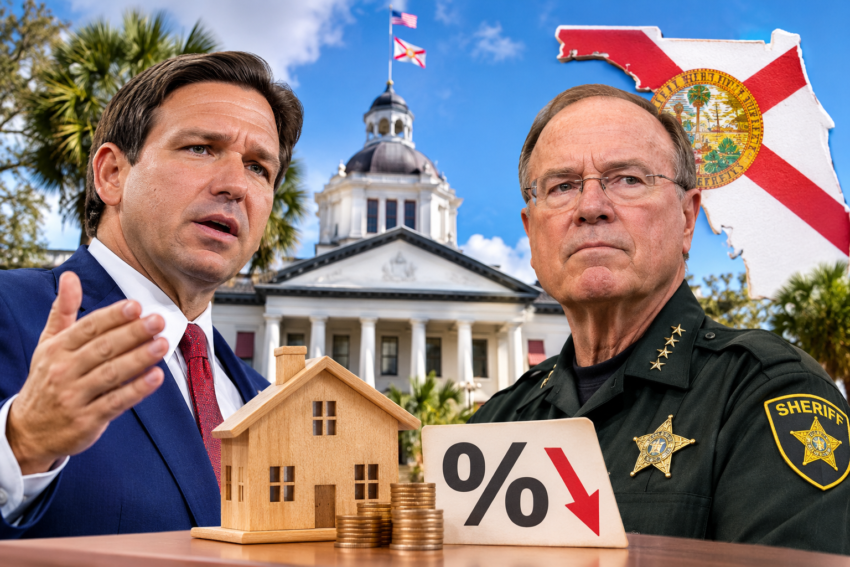
FLORIDA — Grady Judd is not an ordinary sheriff. The 72-year-old law enforcement official from Polk County, Florida, has built a social media following of nearly four million people through videos featuring his blunt humor, Southern drawl, and colorful descriptions of criminal cases.
In one video, he described a suspect in unusual terms. In another, he appeared at a drug raid press conference wearing a gold chain while declaring that authorities had seized the suspects’ money, weapons, and drugs.
One of his most popular clips features the arrest of an 18-year-old who allegedly threatened to shoot people at a McDonald’s after receiving an incorrect order. Judd nicknamed the suspect “McNut.” The video has attracted more than 21 million views.
“For me, this is just another day at the office,” Judd said.
But in the days leading up to Florida’s November 3 election, the sheriff has found himself at the center of a political fight that reaches far beyond law enforcement.
Judd, a Republican, has become one of the most prominent opponents of Amendment 3, a proposed constitutional measure that would significantly reduce property taxes for homeowners across the state.
The proposal has exposed tensions within Florida’s Republican Party, forcing conservatives to confront a difficult question: How far should the government go to cut taxes if doing so could weaken essential public services?
A Tax Cut With Major Financial Consequences
Amendment 3 would increase Florida’s homestead property tax exemption for non-school taxes from $50,000 to $150,000 in 2027 and $250,000 in 2028.
Supporters say the measure would provide meaningful financial relief to homeowners struggling with rising living costs. Opponents warn that local governments could lose billions of dollars in revenue, potentially forcing them to reduce services or cut staff.
The amendment requires approval from at least 60 percent of voters to pass.
“This is a train wreck,” Judd said, describing the proposal as one of the most extreme constitutional amendments he had ever seen.
At a recent press conference, Judd stood behind a podium bearing the words “Too Good to Be True” and argued that the measure would leave local governments struggling to maintain essential services.
“This is not cutting government budgets with the right tools and scissors,” he said. “This is cutting them with a lawn mower. The result will be terrible.”
For Judd, the proposal represents a direct threat to public safety funding.
He has also accused its supporters of turning a legitimate debate over tax relief into a political maneuver that could undermine police departments, firefighters, and other local services.
Republicans Divided Over Property Taxes
Amendment 3 has created an unusual split among Florida Republicans.
Governor Ron DeSantis supports the proposal, as does Republican gubernatorial candidate Byron Donalds, who has called for sweeping reform of the state’s property taxes and fees.
DeSantis initially expressed reservations about the amendment, arguing that it did not go far enough. However, he later began actively campaigning for its passage, appearing at public events and on Fox News to encourage Republican voters to support it.
At a recent town hall in Miami-Dade County, DeSantis dismissed warnings from local officials about potential budget shortfalls as a false narrative.
Judd strongly disagrees.
He has described the amendment as a political stunt that would effectively reduce funding for law enforcement. His position is backed by the Florida Sheriffs Association, the Florida State Fraternal Order of Police, and Florida Professional Firefighters.
These organizations traditionally draw support from conservative voters, making their opposition particularly significant.
Democratic gubernatorial candidate David Jolly has also criticized the proposal, arguing that it could weaken law enforcement budgets and other essential public services.
The debate marks an interesting shift in American politics. While calls to reduce police funding have often been associated with progressive movements, a Republican sheriff is now warning that a tax-cutting initiative backed by prominent conservatives could produce similar consequences for public safety.
Supporters Promise Thousands in Savings
Supporters of Amendment 3 argue that Florida homeowners deserve relief after years of rising property taxes.
Margy Grant, chief executive of the Florida Realtors advocacy group, said the average homeowner could save approximately $1,000 in 2027 and $1,800 in 2028 if the amendment passes.
Florida Realtors has contributed $21 million to the campaign supporting the measure.
“That’s money that families can use for groceries, insurance, utilities, childcare, or simply keeping up with the rising cost of living,” Grant said.
Property taxes across Florida have increased substantially over the past decade, rising by an average of 99 percent across counties, according to figures cited in the debate.
Grant argues that local governments have benefited from significant revenue growth and should be able to operate more efficiently without collecting as much property tax.
She also rejected claims that the amendment would undermine essential services.
“I think that people are severely underestimating the effectiveness of our local elected officials,” she said, dismissing predictions of severe service cuts as exaggerated.
Supporters also argue that reducing property taxes could make homeownership more affordable for existing residents who are struggling to keep up with rising expenses.
However, the potential effects on the housing market remain a concern. Realtor.com has estimated that home prices in Florida could rise by approximately 9 percent as buyers gain additional purchasing power.
Asked about the possibility that higher home prices could offset some of the benefits, Grant said her organization’s primary objective was helping current homeowners remain in their homes.
Local Governments Face Billions in Potential Losses
The financial stakes are substantial.
Florida’s Office of Economic and Demographic Research estimates that local governments across the state could collectively lose $13.7 billion in revenue during the first two years if Amendment 3 passes.
Property taxes are particularly important in Florida because the state does not levy a personal income tax. They account for a major share of the funding available to local governments.
The potential impact would vary across communities.
Miami-Dade County, one of Florida’s most expensive property markets, could face an estimated $1.5 billion in lost revenue over two years, according to the Florida Policy Institute.
However, advocates against the amendment are especially concerned about smaller communities with fewer alternative sources of income.
The Florida League of Cities has warned that smaller or economically weaker municipalities could experience greater financial pressure relative to their budgets.
According to the organization’s analysis, public safety accounts for approximately 90 percent of property tax revenue in Florida cities with fewer than 5,000 residents.
In cities with populations above 25,000, public safety spending is already at least 1.4 times greater than property tax revenue, meaning these communities depend on other sources of funding to support their police and emergency services.
A substantial reduction in property taxes could therefore leave some municipalities with difficult choices about how to pay for essential services.
Polk County Could Lose $365 Million
Polk County, located between Orlando and Tampa, illustrates the challenges local governments could face.
The county could experience a recurring revenue loss of approximately $365.6 million if voters approve Amendment 3, according to figures cited in the debate.
Judd said local officials would likely begin by cutting services considered necessary but not central to government operations.
Among the programs potentially affected are school crossing guards, which he said cost the county approximately $2.5 million annually, and animal control services.
Staffing cuts could follow.
According to Judd, approximately 80 cents of every dollar in the Polk County Sheriff’s Office budget goes toward employee salaries and benefits.
If local revenues decline significantly, he warned, the county could be left with fewer police officers and firefighters.
Such reductions, he argued, could undermine public safety at a time when residents continue to expect reliable emergency response and law enforcement.
The amendment’s supporters, however, maintain that local governments should be able to adapt their budgets and find more efficient ways to deliver services.
The central question is whether those savings would be sufficient to offset the projected revenue losses.
Tax Reform Remains Popular Among Voters
Despite the disagreement over Amendment 3, property tax reform remains popular among Florida residents.
A poll released earlier this year by the James Madison Institute found that 92 percent of Floridians said their cost of living had increased, while 77 percent supported some form of property tax reform.
Judd said he supports tax cuts in principle, describing them as a sound conservative policy.
However, he believes the state should pursue alternatives that would not place essential services at risk.
One possibility, he suggested, would be increasing sales taxes to offset reductions in property taxes, although such a change would present its own policy challenges.
For Judd, the problem is not the idea of reducing taxes but the scale and potential consequences of the proposed amendment.
He has urged voters to consider the long-term effects on their communities before deciding whether to support the measure.
As the November 3 vote approaches, Florida’s property tax battle has become a test of competing conservative priorities: lowering the tax burden on homeowners and preserving the public services on which communities depend.
Judd has promised to continue pushing for tax relief if Amendment 3 fails.
“I promise you that when I wake up on November 4, if Amendment 3 has not passed, I will immediately begin leading an effort for appropriate tax savings,” he said.
For Florida voters, the decision is not simply about how much tax they should pay. It is also about what their communities can afford to lose. ***